

Disagree and Commit: A 5-Step Playbook to Make Faster, Smarter Decisions
How to speed up decision-making in your team without collateral damage


Companies face two major challenges when making decisions. The first is arriving at the decision itself. The second, and the most critical, is ensuring everyone is on board. Even the best decision will fail if your team doesn't support it and commit to making it work.
Imagine the captain of a ship planning a trip. Ensuring the crew is committed to the journey is as vital as charting the right route. If the team secretly doubts the journey's success, the result is a voyage featuring mutiny and mistrust.
Driving alignment is a tricky concept, as I discuss in a previous post. Rushing your team into alignment might result in hurried agreements, but not genuine commitment. You don’t want to discover that the crew wasn’t really on board when facing a storm.
The sooner a team deals with disagreements, the better.
Instead of pursuing the illusion of alignment, great leaders open the floor and invite teammates to voice their differences. However, a never-ending debate isn’t productive either. That's where the "Disagree and Commit" principle comes in. Once a decision is made, everyone must commit to its successful implementation, regardless of their previous viewpoints.
“Disagree and Commit” is more than just a catchy phrase; it’s an effective principle that drives team members to support a decision, especially when they initially disagreed. However, simply throwing the phrase around won’t improve your team’s decisions.
In this post, I will not only explain how the "Disagree and Commit" principle works but also share a step-by-step process for you to try it out with your team.
“Disagree and Commit” Speeds Up Decision-Making
Few words have such a bad rap in the corporate world as “disagreement.” Leaders are meant to align team members, so disagreement is often seen as a failure. However, fake alignment is much more dangerous than disagreement. Great leaders promote dissent rather than shy away from it.
No one encapsulated this tale more than General Motors' former CEO, Alfred Pritchard Sloan. He famously wrapped up a crucial meeting by asking, “Gentlemen, I take it we are all in complete agreement on the decision here?” He then waited as each committee member nodded in agreement.
Sloan's response caught everyone off guard. He suggested, "Let's postpone further discussion of this matter until our next meeting. This will give us time to develop disagreement and perhaps gain a better understanding of what this decision is about.”
Leaders often focus on driving compliance and rush people to align, even at the expense of real commitment. They confuse alignment with consensus. Instead, Sloan intentionally challenged the illusion of alignment – he avoided the Consensus Trap.
Have you ever been in a meeting where everyone seems to support a decision, but you can see disagreement all over their faces? No one dares to speak up. Remaining silent is the easiest way to avoid responsibility, so everyone goes along with the charade, and the meeting ends with a superficial agreement that lasts less time than a bio break. That’s the Consensus Trap.
A weak workplace culture often stems from a lack of genuine commitment. It’s easier to criticize someone else’s ideas than to help improve or develop better ones. Remaining silent in the face of issues is akin to being complicit. A lack of commitment quickly goes viral, promoting groupthink rather than collaboration. Additionally, agreeing with an idea without committing to its proper execution can ultimately lead to its failure – even if it was a great idea to begin with.
The best way to avoid groupthink – and make better decisions – is to turn dissent into a force for good, just like Sloan did.
"Disagree and Commit" is the most frequently referenced among Amazon's leadership principles. In his 2016 letter to shareholders, Jeff Bezos described the concept of respectfully disagreeing but wholeheartedly committing to a decision once it has been made:
“Have backbone, disagree and commit.
Leaders are obligated to respectfully challenge decisions when they disagree, even when doing so is uncomfortable or exhausting. Leaders have conviction and are tenacious. They do not compromise for the sake of social cohesion. Once a decision is determined, they commit wholly.”
The “Disagree and Commit” principle ensures everyone's perspectives are heard and respected, promoting ownership and inclusion. This approach avoids the problems that come with forced consensus or analysis paralysis. It helps balance and maintain diversity of thought as well as speed up decision-making.
There are two parts to it. First, expecting and demanding teammates to voice their different viewpoints. Second, once a decision has been made, everyone commits to its success no matter their points of view. This cultivates genuine alignment and increases accountability.
Adopting this principle is easier said than done. It requires a psychologically safe culture and intellectual humility from both leaders and team members. Practicing "Disagree and Commit” requires genuine respect for different viewpoints, not being emotionally attached to our ideas, and being able to revise and change our perspectives in light of new information.
In addition, you need a clear process to facilitate dissent and turn the principle into a digestible, actionable practice.
Disagree and Commit: Step-by-Step Process
Here’s a simplified version of the “Disagree and Commit” process I use with my clients. It promotes a bias for action: Decisions aren’t permanent – you can always iterate on or reverse a decision.
The process includes five steps: Propose, Disagree, Decide, Commit, and Implement. Let’s go through each step.
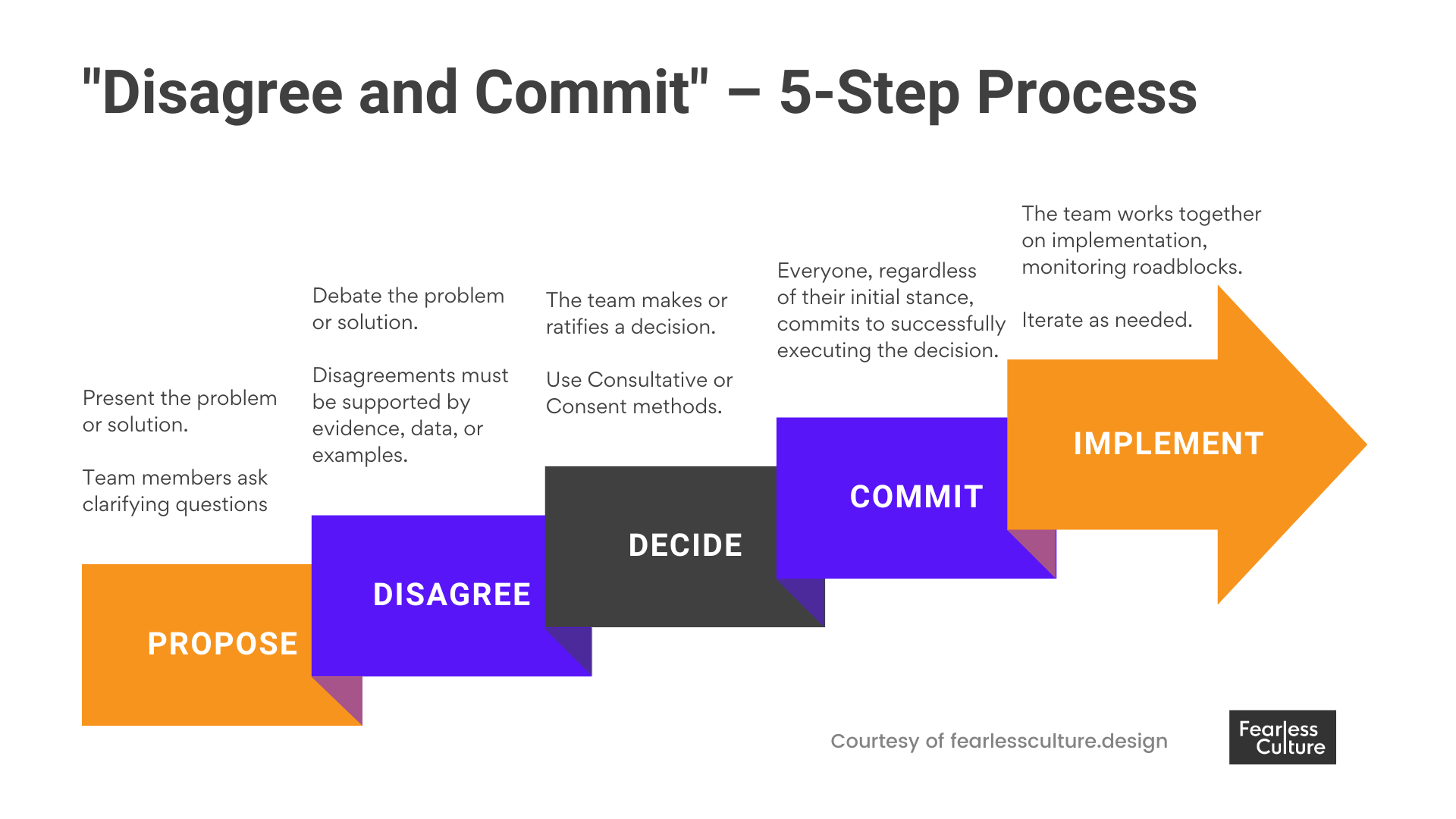
1. Propose
The whole process starts with a proposal from either the leader or team member. Although the proposal often comes in the form of a recommended decision, it can also include presenting a challenge to the team to get everyone’s views.
A clear, well-crafted proposal makes the process easier – it’s essential that the proposer prepares ahead of the meeting.
Before moving to step 2, ensure that everyone has all the facts and, most importantly, understands the proposal. Encourage team members to ask clarifying questions to get all the necessary details and avoid misunderstandings. Questions are meant to facilitate understanding, not express opinions. It’s crucial to have a facilitator ensure everyone abides by this rule.
2. Disagree
Encourage team members to express their opinions healthily and constructively, whether it’s about a recommended solution/ decision or a problem that the team needs to discuss. One by one, each member can share their reactions and disagreements – if any.
Before sharing their reactions, invite people to reflect on what drives their disagreement: Is it genuine or driven by personal biases? Make sure rigid mindsets or emotional issues are not getting in the way.
Everyone who disagrees now gets their turn to present their arguments. All disagreements must be supported by facts, data, or examples.
Beware of silence, as it can be misleading. Don’t assume that those staying silent agree with the proposal. Encourage people to clearly state their point of view, including whether or not they disagree with the proposal.
Use the following questions to help team members reflect:
What specific concerns or reservations do you have about the proposed decision?
Can you provide evidence, examples, or data to support your disagreement?
Are there any external factors or influences that you think we might be overlooking?
How could this decision harm the team based on your perspective?
Are there alternative solutions or strategies which you believe we haven't considered?
3. Decide
After the debate, a decision must be made. It could be ratifying the original decision or coming up with a revised one based on the team’s discussion.
Depending on the team’s operating norms, decisions may be made using either a consultative or a consent approach. In the first scenario, the leader decides while considering the input from all team members. In the second option, teammates address objections and eventually agree to support the decision, even if it’s not their preferred option – they give consent.
Hint: Don’t confuse consent with consensus (read this to learn the difference).
4. Commit
“Look, I know we disagree on this but will you gamble with me on it?” — Jeff Bezos.
This step is more than just a declaration of support – it is an acid test to ensure that people are truly committed to executing the decision.
Committing means that whatever the final decision is, all team members will do everything possible to implement it successfully.
So, why would people commit to something they originally disagreed with?
For starters, everyone had the chance to express their viewpoints and differences. Some may have changed their minds during the debate, while others didn’t. However, everyone felt both included and heard.
Additionally, the process allows naysayers to confirm their hypothesis (that it was a bad call). The last thing a team wants is for an idea to fail because it was poorly executed.
Andy Grove, former CEO at Intel and early adopter of the “Disagree and Commit” principle, said it best: “If you disagree with an idea, you should work especially hard to implement it well because that way when it fails you’ll know it was a bad idea. Not bad execution.”
This bias for action helps align the team.
Use these questions to encourage genuine commitment rather than just a declaration:
Do you understand the final decision, and are you willing to support it fully?
Now that the decision has been made, what support or resources do you need to commit to it?
On a scale of 1-10, how committed are you to making this decision work? What would it take to move that number closer to 10?
What would be your immediate next steps to align with this decision?
How can we hold each other accountable during implementation?
5. Implement
Once the decision has been made and the team is aligned, the final phase begins. This step is where the rubber meets the road. It involves breaking down the decision into actionable tasks, responsibilities, and timelines.
The team works together with total commitment from all members to launch a new feature, implement a new process, or any other necessary action. Even those who initially disagreed with the idea will work wholeheartedly towards its success, having had the chance to express their opinions.
As the team progresses, it's crucial to have regular check-ins to monitor progress and identify any potential roadblocks or necessary adjustments. This iterative approach ensures the decision is effectively implemented, fostering a culture of adaptability and resilience.
How to Make Commit and Disagree Work
"Disagree and Commit" isn’t just a catchy phrase but a powerful principle that can transform how your team makes decisions. Encouraging open disagreement and requiring full commitment ensures that diverse opinions are heard without slowing down the process. It fosters a culture of respect, collaboration, and ownership, leading to more successful outcomes.
There’s a catch: This approach cannot be applied blindly. Without clear, ethical boundaries, it can quickly turn into “Whine and Shut Up” – forced compliance disguised as open debate.
The mother of all ironies came from the godfather of “Disagree and Commit,” Amazon itself. Recently, Mike Hopkins, SVP of Prime Video, reportedly instructed people to return to the office, saying, “It’s time to disagree and commit. We’re here; we’re back – it’s working. I don’t have data to back it up, but I know it’s better.”
Remember: the power of "disagree and commit" lies in genuine alignment, not in using it as a tool to suppress dissent or force buy-in.
If you’re wondering how I can help your team make faster, smarter decisions, schedule a free consultation with me.