

How to Build a Culture of Ownership (Exercise)
An activity to promote agency and responsibility, not just compliance

If accountability is so important at work, why do most organizations fail to build a culture of ownership?
For starters, accountability is often treated as punitive rather than motivational – it’s promoted after the fact. 80% of employees report receiving feedback only when things go wrong. A lack of clear priorities and expectations may jeopardize the organization’s key results. And almost 90% of executives are not sure what their organizations are even trying to achieve.
Ironically, while most people believe leadership behavior makes or breaks accountability, 82% of leaders feel they have limited ability to hold employees accountable. They either try but fail or avoid it altogether.
The fundamental problem with accountability is that it fosters a culture of blame, control, and judgment. It leads to fear rather than promoting pride and motivation.
To turn things around, organizations should cultivate a culture of ownership. The more people feel they own their work, the more accountable they become.
I’m here to share an exercise I use with my clients to build a culture of ownership, but let’s first explore the differences between accountability and ownership.
Make Ownership, Not Punishment, the Goal
“When you got a job to do. You got to do it well. You gotta give the other fella hell!” – Paul McCartney
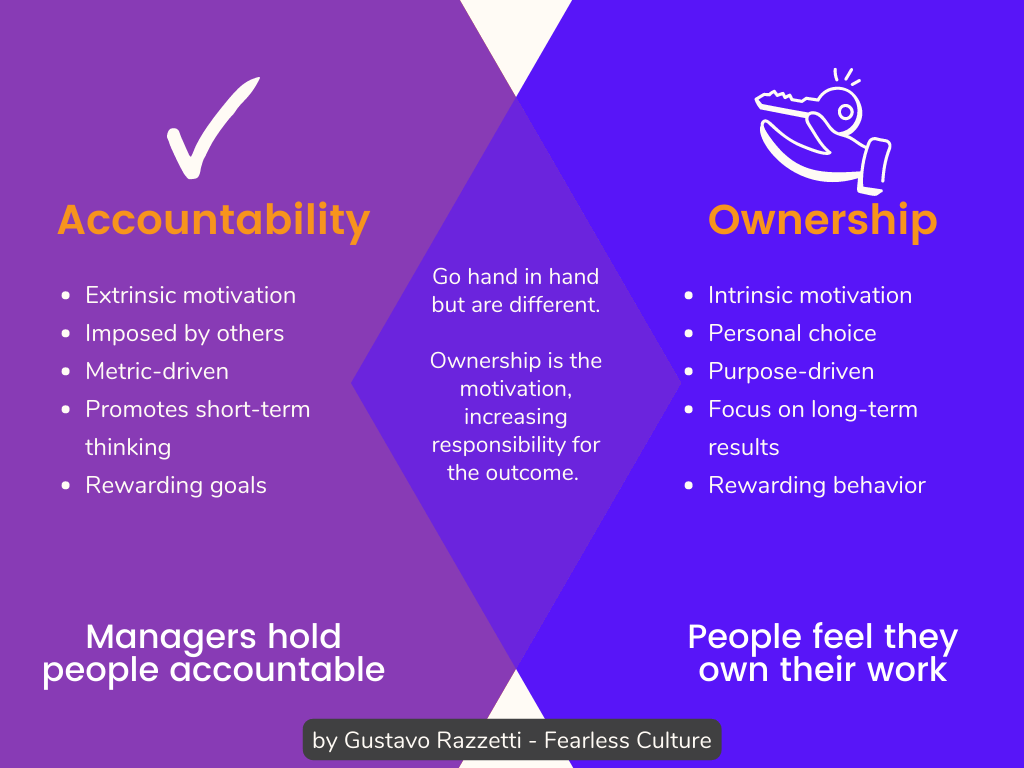
The paradox of accountability is that, if it’s absent, people don’t take obligations seriously. However, when accountability is imposed, it creates the opposite effect.
While accountability involves doing what's rewarded or measured, ownership is the pride and commitment in doing great work. One is imposed; the other happens from within.
Ownership drives people to go above and beyond. It’s about feeling in charge and doing whatever it takes to achieve your goals. It creates a powerful emotional connection.
Behavioral scientist Francesca Gino wrote, "The state of psychological ownership is not only cognitive but also affective: simply by calling an entity — whether an object, another person, or a job — 'mine' suggests that we have an emotional connection to it."
Accountability and ownership, while interconnected, have different effects on workplace culture. Accountability, often imposed and measured, can cause stress and anxiety due to its ties to punishment. Employees understand what they are accountable for, but the pressure to perform can make them feel threatened.
Accountability is the responsibility of completing a task or achieving a goal. Ownership is about setting a high bar for oneself.
Building a culture of ownership includes three key elements: efficacy (the satisfaction of creating results), self-identity (personal attachment to a job or purpose), and belonging (the human need for connection). Studies have found that psychological ownership enhances job satisfaction, commitment to the organization, and performance.
In fearless cultures, the drive for achievement comes from a strong sense of ownership, not external pressure. Employees with a sense of ownership are proactive and committed: They don’t need to be told to pick up the trash.
Exercise to Build a Culture of Ownership
Discuss the following five principles with your team. Allow time for individual reflection on the questions provided for each step. Afterward, collectively brainstorm ideas to start developing or continuing to develop each of the five principles within your team.
1. Focus on Meaningful Work, Not Just Goals
The secret of a successful organizational culture lies not in just meeting goals but in allowing employees to do meaningful work. Research consistently shows that job satisfaction and engagement skyrocket when employees love what they do. Our culture study uncovered that 76% of executives believe that doing great work separates the best cultures from the worst.
We don’t just want to make money, but also to be part of something bigger than ourselves. Purpose is more than just a buzzword. Doing meaningful work increases engagement by 2.3 times, according to research. We experience work as meaningful when we can explore, experiment, and make an impact.
Warby Parker was created with two goals in mind: to offer stylish, affordable eyewear and solve problems instead of creating them. Its “buy a pair, give a pair” program provides affordable glasses to low-income people. Since day one, Warby Parker has distributed 15 million pairs of glasses – that’s quite a number for those who think purpose-driven companies are a scam.
Reflection Questions:
How does your current work align with your personal values?
Think of a recent project where you felt deeply fulfilled. What elements made it meaningful to you?
What elements of your work do you find the most fulfilling, and why?
What changes would make your everyday tasks feel more impactful?
What steps can your team take to help you find more meaning in your work?
2. Delegate Decision Authority to the Lowest Possible Level
Managers often expect people to become more accountable without giving them the power to make decisions. Distributing decision-making rights to those closest to the work results in quicker and better outcomes, since those closer to the problem have the interest and knowledge to solve things faster.
Toyota revolutionized the automotive industry by allowing any employee to stop the manufacturing line. The Andon Cord became the best example of delegating authority to the lowest possible level. Anyone in the assembly line could stop production when they identified a quality problem. Pulling the chord wasn’t about making employees powerful but prompting them to feel ownership of the outcome – high-quality cars.
A growing number of companies such as Amazon, Zappos, and The Ritz Carlton have shifted decision making rights to those closer to the customer or issue. Even blue-collar manufacturing plants like Morning Star have realized that front-line employees can make better-informed decisions than executives at headquarters.
Reflection Questions:
Which decisions could you manage that currently require higher approval?
How much freedom do you feel you have to make decisions in your current role?
What obstacles prevent senior executives from delegating more decisions to frontline employees?
How can your team prepare (or train) employees to make better decisions?
What cultural shifts are required to decentralize decision-making?
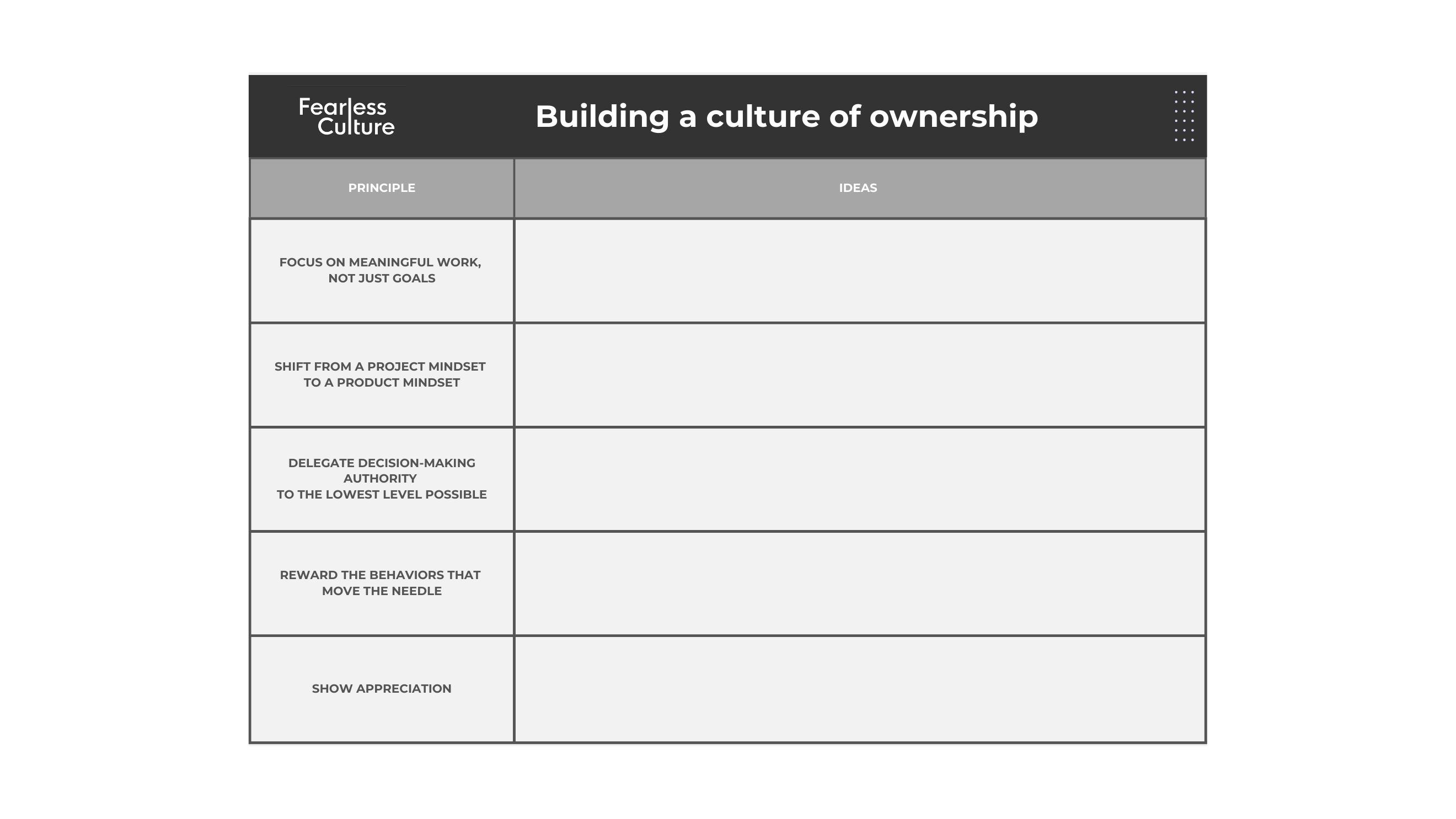
3. Shift from a Project Mindset to a Product Mindset
Transitioning from a project to a product mindset is not just a play on words. Projects make us focus on deliverables and deadlines. However, a product mindset encourages us to focus on the impact, not just compliance.
Often, teams delivering a project have no say, or almost none, about what they’re delivering. They just have to make sure they’re delivering. However, adopting a product mindset means that the team is not only accountable for delivering but also cares about the outcome and impact.
A product mindset, unlike a project mentality, is an ongoing process. It’s focused on outcome, strategy, and the long term. Instead of a clear end, it promotes continuous improvement.
Apple is known for its product mindset, where teams are responsible not just for fixing bugs but also for features. At Apple, everyone cares about creating an outstanding user experience.
Reflection Questions:
How would your role change if you adopted a product rather than a project focus?
What are the long-term advantages of a product mindset for your team?
What skills or resources would you need to effectively adopt a product-focused approach in your role?
How can your culture support a transition from a focus on project outcomes to impact-oriented work?
What challenges might arise with this shift, and how can they be mitigated?
4. Reward the Behaviors that Move the Needle
What you reward is what you get. In a metric-driven world, it’s easy to become fixated on KPIs and lose perspective of what really drives results. Rather than rewarding the act of achieving a goal (often pushing people to cut corners), encourage the behaviors that will take you where you want to go.
Mailchimp learned to reward behaviors that actually move the needle. Accountability is not about hitting a target but doing what’s right so you’ll hit your goals consistently.
Best Buy’s remarkable turnaround under CEO Hubert Joly was largely due to a similar shift. Instead of focusing on strict sales targets, he encouraged a client-centric approach. Joly created a culture of ownership by asking store managers, "What does it look like when we are at our best?"
People who help define the bar feel more motivated to reach and exceed their goals.
Metrics matter. However, focusing on doing the right thing is more important. Reward the behaviors that move the needle, not those who are good at beating the accountability system.
Reflection Questions:
How well do you understand the 'why' behind your current business targets?
How has understanding the impact of your work changed how you prioritize your work?
What behaviors contribute most significantly to the long-term success of your team?
What are the flaws in the current rewards system, and how can they be corrected?
What system could be implemented to reward behaviors that move the needle rather than achieve short-term goals?
5. Appreciate People Who Pick Up Trash
Every organization has trash that everyone sees but no one cares to pick up. They ignore it because it’s not their job – and they expect someone else to take care of it. To cultivate a culture of ownership, it’s essential to encourage and appreciate those who take the initiative to address issues, regardless of their role or job description.
At Netflix, for instance, picking up the trash is a metaphor for “taking care of problems, small and large, and never thinking ‘that’s someone else’s job.’” Similarly, IKEA’s “Never with your empty hands” norm encourages employees to take action and fix anything at the store. If a product is missing, an article is broken, or something is dirty, employees just take care of it, no matter their role or department.
Showing appreciation for those who pick up the trash is crucial to building a culture of ownership. Recognize and reward those who go above and beyond. Avoid giving a pass to those who don’t show initiative, as it could send mixed signals to the team.
Reflection Questions:
Think of a time when you or a colleague "picked up the trash" at work. What motivated the action? What can be done to encourage more such proactive behaviors?
How do you personally feel about taking on tasks outside of your usual responsibilities?
What steps can be taken to ensure that all team members feel their contributions, no matter how small, are valued?
How does your current workplace culture support or discourage taking initiative beyond assigned responsibilities?
How might you change the recognition system to include small, often overlooked contributions?
Nurturing a culture where everyone picks up the trash instills a sense of autonomy and ownership.
Building a Culture of Ownership Starts With You
Building a culture of ownership starts and ends with leaders. You don’t need a title to inspire others to pick up the trash. Showing a strong sense of ownership is not only beautiful but contagious. Never underestimate your influence.
Use the following questions to reflect on your behavior.
How can you instill a sense of ownership in your team?
What behaviors are you modeling?
What behaviors are you rewarding?
Do you need help building a culture of ownership? Schedule a free consultation call to discuss how I can support you and your team.