

Why Hope Is a Strategy (Really)
But first, let's stop treating hope like positive thinking


Hope saved my life, literally. Almost twenty years ago, I got lost in Patagonia. The night fell sooner than I expected. A storm came out of nowhere. I panicked. Spending the night in the open wasn’t part of my vacation plans. My wife didn’t know where I was. And soon, that became the least of my worries.
As the temperature dropped, I realized cold wasn’t the only threat. I also had to manage my mind. I looked around for answers. I cut reeds to build a cushion that would protect me from the damp ground. If I fell asleep, I could die.
I made it through the night. But something else didn’t: my old definition of hope.
We don’t realize how powerful hope is until we lose it. At work, what looks like resistance to change is often something else. Most people don’t intentionally boycott the strategy; they stop believing their opinions matter. While researching my book, Forward Talk, I saw a similar pattern. Most people stop speaking up not because they’re afraid, but because it feels pointless. They lose hope their words can change anything.
Hope helped me find my way back after that night. It’s what helps teams push through setbacks. But first, we need to stop treating hope as magic. Positivity alone isn’t enough. You have to do the work.
What Hope Is (and Why We Get It Wrong)
Whenever I introduce the idea of hope to a team, reactions split. Some faces light up. Others look at me with skepticism. That reaction doesn’t surprise me. Most of us learned to define hope in a way that doesn’t hold up under pressure.
We tend to fall into two camps:
Believers: they embrace hope without question, almost like faith. “Hope for the best.”
Skeptics: real work requires willpower and realism. “Hope is not a strategy.”
Both perspectives miss the point because they confuse it with extreme optimism. We treat hope like magic.
Belief alone isn’t enough. Positive thinking can actually hold you back. When people only imagine success, they often put in less effort: job seekers send fewer applications, and dieters lose less than those who picture the obstacles. That’s what psychologist Gabriele Oettingen found when studying positive thinking. Hope without effort is no hope at all.
But dismissing hope is risky, too. Hope is the number one thing people expect from their leaders. According to Gallup’s global leadership survey, 56% of all positive leadership attributes relate directly to hope, outranking trust, compassion, and stability. Yet, only 15% of people think their leadership gives them hope.
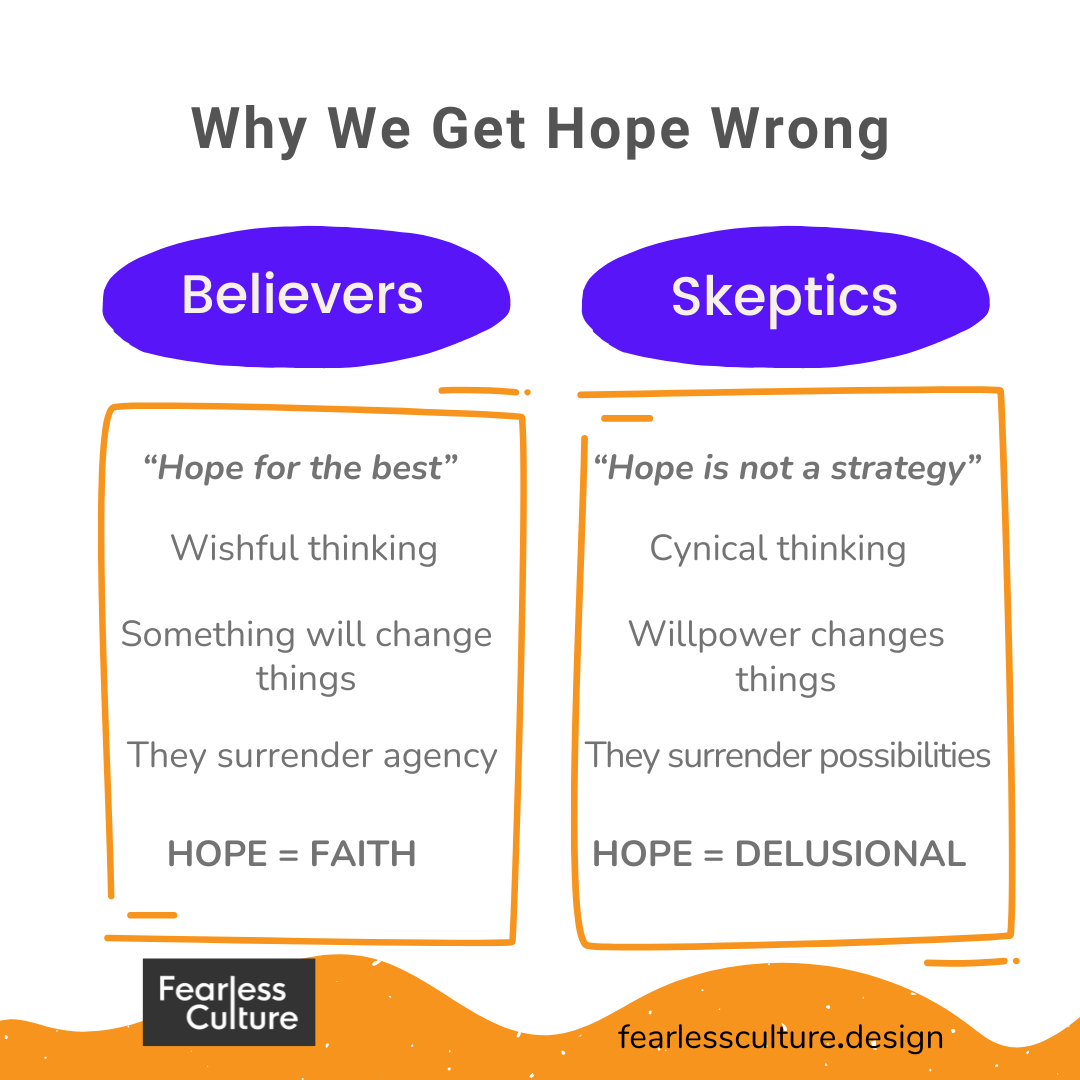
“Believers” are often closer to optimism than hope. When we assume things will work themselves out, we hand away our agency. We end up waiting for someone, or something, to change things.
“Skeptics” call themselves “realistic.” But willpower alone isn’t enough. When things get tough, you still need to believe a better future is possible.
Neither camp would recognize themselves in the other. Yet they have something in common: both treat hope as magic. You either believe in it, or you don’t.
Brené Brown makes a related point from a different angle: hope, she argues, isn’t an emotion at all. Rather, it’s a capability we build through adversity and trusted relationships.
Hope Is Optimism with a Plan
Hope isn’t something you wait for. It’s a signal that tells you where to put your effort. Hopeful people don’t just expect the best; they act. Research links hope to better health, career progress, and meaningful relationships. A longitudinal study of 25,000 people found this after following them over fourteen years. Hopeful people recover faster after setbacks.
At work, hope predicts performance because it supports sustained motivation, beyond what optimism or grit can do.
The same dynamic applies to teams, not just individuals. When teams believe they can reach their goals, burnout drops and commitment rises. Collective hope is contagious.
Behavioral science shows hope requires two ingredients: possibility and agency.
Possibility helps us see options when we feel stuck. Leading with hope requires more than inspiration. People want to explore how to get there.
Agency is believing we can take meaningful action. It reduces feelings of helplessness and anxiety.
That mix is what got me off that mountain. And it’s what can help your team move forward, too.
For example: if your budget is stalled, you could keep waiting for a yes forever. Instead, you could ask finance what’s blocking approval, propose a smaller pilot, or reallocate funds from an under-budget project.
When teams focus on what they can’t control, they become hopeless. One exercise I use with teams is asking people to shift the focus to what they can control. The list is usually much longer than they’d expect. That shift helps people regain agency (and hope).
“Hope without a strategy doesn’t generate leadership. Leadership comes when your hope and your optimism are matched with a concrete vision of the future and a way to get there.” —Seth Godin
Hope is both external and internal. Leaders create the conditions by showing what’s possible, a path to get there, and recognizing progress. People strengthen it by shifting from “someone else will fix it” to “here’s what I can do.” Hope is a signal. It’s evidence that makes the next step easier.
Hope isn’t a promise that things will work out, but a reason to keep going. It makes the effort, the sacrifice, and the trust worthwhile.
Put Hope to Work at Work
Here are five ways to turn hope into action.
1. Build momentum with quick wins
Progress creates hope, and hope builds progress.
Managers often assume people are motivated by recognition, interpersonal support, and incentives. Research by Teresa Amabile shows otherwise. People are driven by intrinsic motivation. Making progress on a task, even a small win, creates momentum.
Nothing builds hope faster than progress. Focus on quick wins this week. Celebrating progress builds hope. It helps people believe that dreams are possible.
2. Make hope contagious
Hope spreads. So does hopelessness.
Team members catch moods fast, often before anyone says a word. Sigal Barsade’s research found that one person’s mood can shift how the entire group cooperates.
Creating a culture of hope starts with you. If you expect the worst, that’s the team you get. If you believe a better future is possible, others are more likely to follow.
3. Restore ownership during change
Change is hard. Losing control and continuity can make people feel powerless.
Giving employees a real voice during a reorganization matters more than providing support or good communication. Research shows that perceived control makes people more open to change. People who helped make decisions and took responsibilities accepted change faster than those who didn’t.
Having a seat at the table (no matter how small) gives people hope.
4. Build your team’s resilience
Setbacks don’t break hopeful people. They help people consider other options faster.
Resilience isn’t a personality trait but a mindset. Hopeful people don’t give up easily. When facing a hard problem, like when I had to survive the cold weather, they try new ways to solve it. Charles Snyder, the psychologist behind the original hope research, found that hopeless people stop trying sooner and feel worse about the task.
Resilience doesn’t mean being stubborn or overconfident. Hope helps us act like water, to always find another path forward.
5. Turn hope into a shared belief
If hope is powerful at an individual level, imagine what it can do when it becomes a shared belief.
Collective hope is a team’s shared confidence that goals are reachable. It’s like alignment on steroids. A study shows that collective hope reduces burnout during high-stress moments. It’s the belief that your organization can set clear goals and has the willpower to achieve them. This isn’t just a mood. It gives people the confidence that they can consider potential barriers and workable solutions.
Collective hope strengthens employees’ emotional commitment to the organization.
Between Possibility and Agency Lies Hope
To build a change-ready culture, treat hope as a skill. Hope is more than positive thinking. It’s the belief that your effort can make a difference. You can’t know for sure whether the outcome will be positive. But hope keeps you focused.
That’s what got me off that mountain. Not toxic positivity (imagining that morning would come), but focusing on what I could control—exploring possibilities, building shelter, and staying awake.
Hope lives between possibility and agency. Dream a future bigger than the present, then move toward it. Take the first step before you feel ready. Hope makes taking risks worthwhile.
Need help building hope on your team? Reach out, and let's discuss how I can help.
Really great work here! The intertwined relationship between hope and trust show up throughout, and in what I've seen. It's so hard to have one without the other. One of the bigger elements of hope that you touch on are realistic (even if challenging) goals. Hard as a team to have hope if the goals are out of reach.