

What Is Conversational Debt and How to Break Free
The compounding costs behind your team’s recurring frustrations. And how to start paying it down.

Work has never been more connected. And honest conversations have never felt more dangerous.
AI boosts individual productivity at the same rate it erodes trust. And it is not just affecting frontline employees. Managers feel the pressure too. But nobody’s saying so out loud.
It’s getting harder to be honest at work. The most expensive conversations are not the ones that blow up. They’re the ones that never happen.
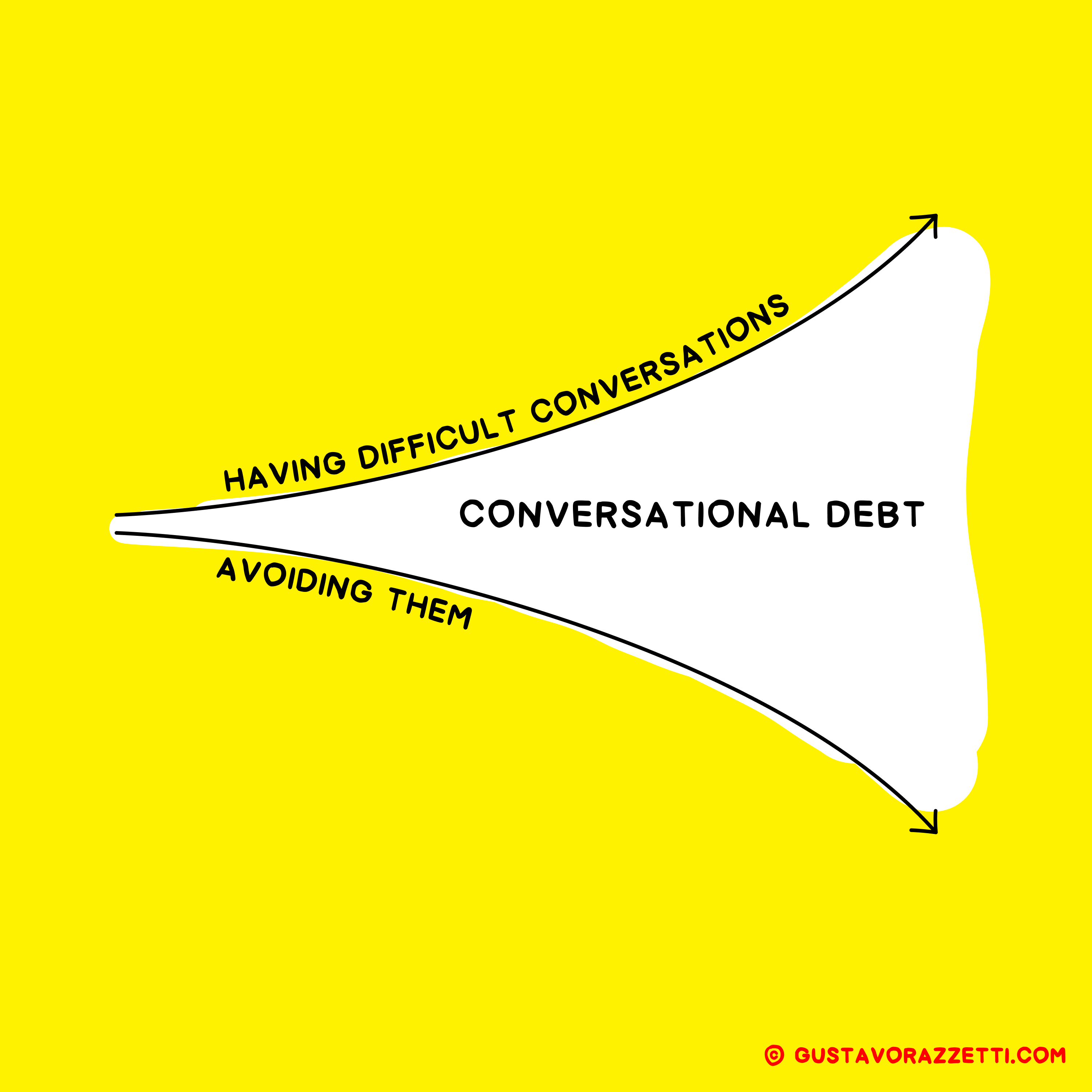
I call this Conversational Debt. It’s not the cause of your team’s dysfunction. It’s the price tag: the cost of unspoken truths, avoided friction, and great ideas that die in silence.
Here’s a preview of ideas I explore in my new book Forward Talk: what conversational debt is, how it spreads, how to measure it, and how to pay it down.
What Is Conversational Debt?
Conversational debt describes the accumulating cost of the crucial conversations your team avoids or handles poorly.
Crises don’t come out of nowhere. They start small and grow until they are out of control. Conversational debt works the same way as financial debt. The longer you wait, the more expensive it becomes to address. Except the currency isn’t money. It’s trust, clarity, and performance.
Think about a parking ticket you meant to pay. You tell yourself you’ll handle it next week. By the time you remember, the $50 fine has become $150 with late fees. A small problem tripled while it sat in your drawer.
That’s how conversational debt compounds:
Conversational Debt = Unresolved Issues × Productivity Loss × Time
Think about a conversation you’ve avoided in the past month. What has it cost you, or your team, so far? Where could small tensions be quietly turning into bigger risks?
These tensions often seem minor at first. Later, it’s clear how quickly the cost grows when we avoid hard conversations or manage them poorly.
The best time to have a difficult conversation is when the issue first surfaced. The next best time is now.
What’s the Cost of Conversational Debt? Why Should I Care?
The cost is staggering. A study by CPP, publisher of the Myers-Briggs assessment, found that U.S. employees spend an average of 2.8 hours per week dealing with conflict alone, costing businesses an estimated $359 billion in lost productivity each year.
Another study found that 43% of professionals spend two weeks or more each year ruminating on unresolved problems. Instead of speaking up, they channel that energy elsewhere: 77% complain to others, 63% do extra or unnecessary work, 57% keep ruminating, and 49% get angry. None of it resolves the issue. All of it drains time, energy, and focus.
In my research with 5,350+ professionals, 82.1% of teams report the same issues resurfacing quarter after quarter. 72.1% say meetings end without real decisions. And 71.2% admit people say “yes” in the room even when they disagree.
That’s the price teams pay for the conversations they avoid or handle badly.
What Are the Three Types of Conversational Debt?
Conversational debt shows up in three ways — and if you’re familiar with my Culture Design Canvas framework, you’ll recognize them as the ABCs of culture: Alignment, Belonging, and Collaboration.
Alignment debt happens when teams confuse agreement with commitment. Everyone nods, then pursues different directions. Everyone heard the same words, but walked out with different interpretations or priorities.
The numbers are clear. A London Business School study of more than 11,000 senior managers found that only one-third could accurately name their company’s top three priorities.
Belonging debt builds when harmony matters more than honesty. People soften feedback, swallow concerns, and stay quiet to avoid being seen as difficult. The team feels good, but performance slips.
“Being one of us” is code for punishing truth-tellers. Naming a flaw or challenging groupthink can get you labeled “not a team player.” The project manager who knows the timeline is impossible stays quiet. The team wins “Best Place to Work” yet keeps losing clients.
Collaboration debt builds when teams can’t reach resolution. Decisions stay open. Meetings end by scheduling another meeting. Everyone stays busy. Nothing gets decided.
A simple test is to ask, “Who owns this decision?” If the answer is vague, hedged, or met with nervous glances, you’re seeing collaboration debt in real time.
Each type is expensive on its own. Together, they compound.
Misalignment creates confusion. Confusion makes people less willing to raise concerns (belonging debt). Then nobody can commit to a path forward (collaboration debt). That reinforces the original lack of cohesion (alignment debt).
Is AI Making Conversational Debt Worse?
Technology amplifies both the good and the bad in any organization. As AI spreads quickly, it accelerates patterns that increase conversational debt in three ways:
Trust displacement. People share concerns with AI instead of with colleagues who need to hear them. Doubts and disagreements get processed in private but never enter the room. Additionally, people are increasingly trusting AI more than their colleagues. Over time, some team members will prefer AI-generated outputs to the judgment of a subject-matter expert.
Converging thinking. When everyone consults the same tools with similar prompts, they often land on similar answers. Everything feels researched and polished. The ideas that surface are remarkably alike, but real thinking requires diverse perspectives and honest debates. Offloading judgment to AI makes people less smart and lowers the bar.
An uncoordinated approach to AI. Most organizations lack a clear vision for AI adoption. They’re watching individuals experiment on their own. Personal initiative is great, but without a shared approach, it creates a new kind of misalignment. People build their own agents, with their own assumptions and logic. There are no shared norms for how those agents should work together, and no shared onboarding. In the end, AI agents are team members, but without clear alignment or accountability.
How Can I Measure My Team’s Conversational Debt?
To address conversational debt, you must first learn to spot it. Unlike financial debt, there’s no statement landing in your inbox. But conversational debt leaves clues in how meetings end, how decisions get made, and what people say after the meeting versus in the room. The patterns are evident once you know what to look for.
In the book, I share a detailed list of signs and patterns to watch for. I also provide a set of statements you can use to assess each debt type. Here’s a short sample:
Alignment Debt
1. We prioritize quick alignment over exploring multiple options thoroughly.
2. We often hear “That’s not what we agreed on,” even after supposed alignment meetings.
Belonging Debt
1. Team members hesitate to bring up risks or unpopular perspectives.
2. We readily offer appreciative feedback but struggle with constructive criticism.
Collaboration Debt
1. When things go wrong, our first instinct is to identify who dropped the ball.
2. We tend to get stuck rehashing past decisions rather than focusing on what to do next.
You can also take the Free Conversational Debt Assessment.
You’ll get a total score and a breakdown by debt type — Alignment, Belonging, and Collaboration. The report explains what your score means, what’s driving it, and where to focus first.
If you want a deeper view, I also offer a paid version for organizations and teams that aggregates results across individuals. It allows you to compare patterns across departments, regions, and levels. What looks like a local problem inside one team often turns out to be systemic when you can see it at scale.
The assessment shows you where you are. The Forward Talk framework gives you the tools to move forward.
Conversational Debt Is Paid One Conversation at a Time
Every team carries conversational debt. The question isn’t whether yours does. It’s how much, and what it’s costing you.
The good news is that debt that builds gradually can be paid down the same way. Not through a cultural overhaul or an offsite retreat, but by consistently choosing to have the conversation that needs to happen over the one that feels safe.
Alignment, belonging, and collaboration debt are warnings, not verdicts. Address them early, and small cracks don’t become structural failures.
Your team can only improve what it actually talks about.
Forward Talk: The Bold New Method For Getting Teams Unstuck is available for pre-order.
The Forward Talk program is open for its first cohort. Join today — spots are limited.