

Great Teams Run on Differences and Common Ground. Most Get It Backward.


Most teams struggle with two problems: mediocre thinking and constant friction. They look unrelated, but I often see them show up together in my client work. Over time, I realized they come from the same source: how teams handle differences.
The first issue shows up when people meet to solve a problem. The start feels strong, but the result is disappointing. Planning sessions that produce a “new” strategy that looks like last year’s. Brainstorms where everyone leaves happy even though they picked the safest idea.
The second issue shows up everywhere else. An email turns into a reply-all war because someone assumed bad intent. A missed deadline that becomes a blame game. Conflict rarely starts with the event. The narrative we create is usually the real reason.
Leaders treat these as two unrelated issues. They want an innovation workshop for the first and a team-building day for the second.
But these aren’t two separate problems.
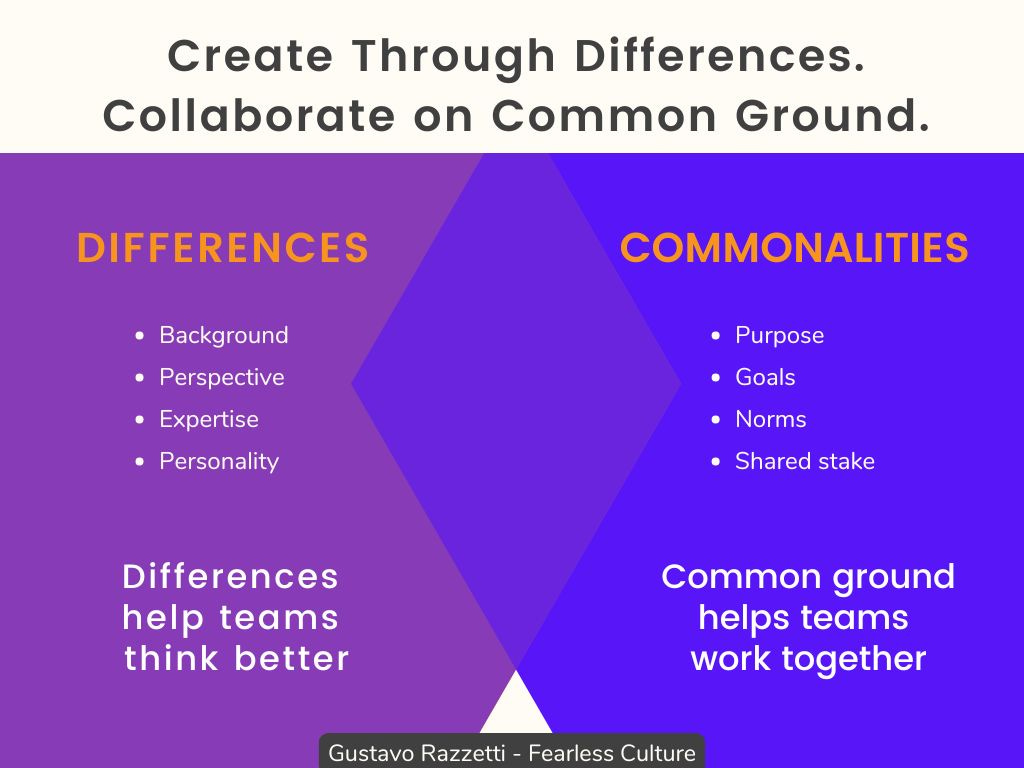
Teams need differences to think better and common ground to collaborate effectively. Most teams get it backward. They reward consensus, which silences differences and leads to mediocre solutions. When conflict hits, they focus on differences instead of common ground, which only deepens division.
Here’s when your team should focus on differences and when on commonalities.
Create Through Differences. Collaborate on Common Ground.
Great ideas come from differences. Creativity happens when perspectives collide: a marketer sees desire, an engineer sees feasibility, a frontline employee sees friction, and a finance leader sees trade-offs. When those views meet and mix, teams can reach solutions no single perspective could create.
A diverse group changes our thinking, even our judgment. Pun intended. Samuel Sommers confirmed this with his mock-jury experiment. Racially diverse juries shared more information than homogeneous ones. Even the White jurors in diverse juries discussed more case facts and made fewer errors. Diversity didn’t change people. It changed how they thought.
Most teams smooth out differences by being nice. That's how groupthink takes over: the group converges on the safest idea and mediocrity wins. Charlan Nemeth tested brainstorming’s golden rule: don’t criticize other people’s ideas. Groups that debated and challenged each other’s ideas outproduced those that didn’t. Avoiding friction doesn’t protect creativity. It shuts it down.
Debate helps you find better solutions and make better decisions. But day-to-day collaboration requires common ground. That's how you turn ideas into results. Execution requires that everyone commit to a direction, regardless of whether they like their colleagues. You can obsess over the differences. Or you can focus on what you share: the same purpose, the same goals, and a stake in shared success.
Common ground keeps differences from turning into rival camps. In one of psychology’s classic field experiments, Muzafer Sherif turned a summer camp of ordinary boys into two hostile groups within weeks. Bringing them together didn’t ease the hostility; sharing lunch only made things worse. But when they had to solve a problem together, things changed. Restoring the camp’s water supply forced them to rely on one another. That shared goal turned enemies into collaborators.
Teams work the same way. When things go wrong, differences in function, tenure, and background quickly create an us-versus-them mentality. A study of 42 top management teams found the same thing. A shared goal brings teams back together (even fractured ones).
Consider a product launch. Marketing wants a bigger campaign and budget. Finance wants tighter timelines and clearer returns. Without common ground, each side starts to see the other as the problem. Use that tension to build a better solution. Then find a shared goal so everyone collaborates during implementation.
Find the right balance. Differences prevent groupthink while common ground breaks gridlock.
How to Build Common Ground
Build common ground before you need it. Once tension hits, the narrative has already taken over: each person explains the issue, focusing on the differences.
Define clear team norms:
We all have different work styles and preferences. Working well together means finding common ground. If one person hates email and another lives in it, if some love casual interruptions and others need deep focus, if someone creates a meeting for everything, frustration builds. Everyone expects others to work their way. Clarity reduces day-to-day friction. I help teams write clear team norms by using the Washing Instructions Canvas.
Align around purpose, not people:
When supporting the strategy means supporting the leader, people manage the leader instead of testing the strategy. A shared purpose shifts the question from “do you support me?” to “do you support this direction?” People don’t need to agree with every decision a leader makes to commit to the purpose.
Define what you reward and punish:
Your culture is the behavior you reward and punish. If you preach collaboration but promote a manager who plays politics, or praise high standards but ignore poor performers, your actions (or inaction) become your culture. Writing down what you reward and punish isn’t enough. People need to see that everyone follows the same rules, especially leaders.
Establish clear trade-offs:
Most cross-functional tension comes from a clash between two good things. Even/over statements settle those fights in advance: speed even over perfection, local clients even over global clients. When push comes to shove, your team needs to know which good thing overrides another. This exercise helps teams navigate competing priorities.
Understand real intent:
When a colleague frustrates you, it’s easy to assume intent. When I ask what happened, people often invent a reason based on differences in style, function, or personality. My advice is simple: manage the behavior, not the intent you assumed. Ask for the real reason before reaching a verdict. This doesn’t mean letting people off the hook. It means not convicting someone without context.
How Differences Can Improve Collaboration
What’s the point of hiring smart people if you expect them to think alike? Backgrounds and perspectives matter. A new hire sees what everyone else stopped seeing. An outsider knows how other industries solve the same problem. Yet, in many meetings, disagreement gets labeled as “difficult.” Real team players speak their minds instead of seeking consensus.
Play devil’s advocate:
Treat dissent as a role, not a problem. The advocate’s job is to poke holes in an idea or bring counter-evidence: “What are we not seeing?” “What information are we ignoring?” “What’s the worst case if we’re wrong?” Rotate the role so no one gets labeled as the difficult one. Good devil’s advocates challenge ideas, not people.
Brainstorm in silence:
In group brainstorming, louder voices take over, and the first idea spoken can anchor everyone’s thinking. Have people write their ideas before anyone speaks. This gives reflective thinkers time and prevents leaders or loud voices from dominating the conversation. You can use the same approach for selecting ideas: have people vote silently before discussing.
Explore three perspectives:
I use this to help my clients make better decisions by looking at a problem from different angles. The Champion makes the strongest case: what could go right, the evidence, and why it will work. The Explorer maps the terrain: what options haven’t been considered, and what a different approach could look like. The Skeptic stress-tests assumptions: what we take for granted, where it could go wrong, and the questions we haven’t asked.
Each role balances the others.
Protect dissenting voices:
Every team has canaries in a coal mine: people who spot threats before they affect others. The engineers who warn about flawed features, the new members who see what others stopped seeing, the contrarians who ask the questions others avoid. Protect and amplify their insights instead of dismissing them as pessimistic, inexperienced, or disruptive. Ask directly: “Who has reservations?” Then listen.
Treat silence as disagreement:
Quick unanimous agreement should worry you. Silence isn’t support until it’s tested. Instead of asking “everyone agree?”, invite dissent: “I’d like to hear from those who disagree. What am I missing?” Real alignment survives scrutiny. Fake agreement falls apart when challenged.
Argue More, Fight Less
Mediocre thinking and constant friction come from the same source. I hope you can see the pattern now. Rewarding consensus silences the differences your team needs. Fixating on differences pulls people apart.
Your team needs both: differences to think better, and common ground to work together.
Arguing is okay. Fighting is not. Most teams get it backward.
Better decisions start with better conversations. Let's explore what's holding your team back.
Work with Gustavo:
Check my new book Forward Talk: The Bold New Method for Getting Teams Unstuck
Join the Forward Talk program. Better teams start with better conversations. Join the September cohort.