

Ideas That Catch Fire (Exercise & Template)
How to Design a Culture of Fire Starters to Spread Change

Imagine what life would be like if we never discovered fire.
We’d be stuck in caves, eating raw food, and hiding from predators at night. No cities. No computers. No birthday candles. Fire didn’t just make life safer; it made civilization possible.
But what if someone killed that idea before it started?
What if a leader dismissed fire because it was too risky? What if others argued, “That’s not how we do things here,” or “It won’t work when it rains”?
Thankfully, someone not only started the first fire (this happened 350,000 years earlier than we thought), but others supported the idea and adopted fire. And that event changed civilization forever.
Organizations face this same dilemma every day.
When someone has a new idea, will others support it or dismiss it? The problem isn’t that organizations lack good ideas but that they lack the right culture. Most initiatives never get a chance. They die before they catch fire.
I help organizations build cultures that don’t just promote but also support innovation and change.
In this article, I’ll share the same four-step approach I use with my clients to create a culture where ideas catch fire. I will also share the tools and templates I use with them.
Build a Culture of Fire Starters (And Spreaders)
Let’s start with the big picture. To drive culture change or spread new ideas, you need four roles: Fire Starters, Fire Spreaders, Fire Guardians, and Fire Users.
Most organizations focus on innovators. They celebrate people who challenge the status quo or create breakthrough ideas (Fire Starters). However, starting a fire isn’t enough. You also need Spreaders who see the potential and can help extend the idea to other teams. You need Guardians who improve the system—norms, rules, advocacy—to keep the fire going, and you need Users who benefit from the new ideas or practices.
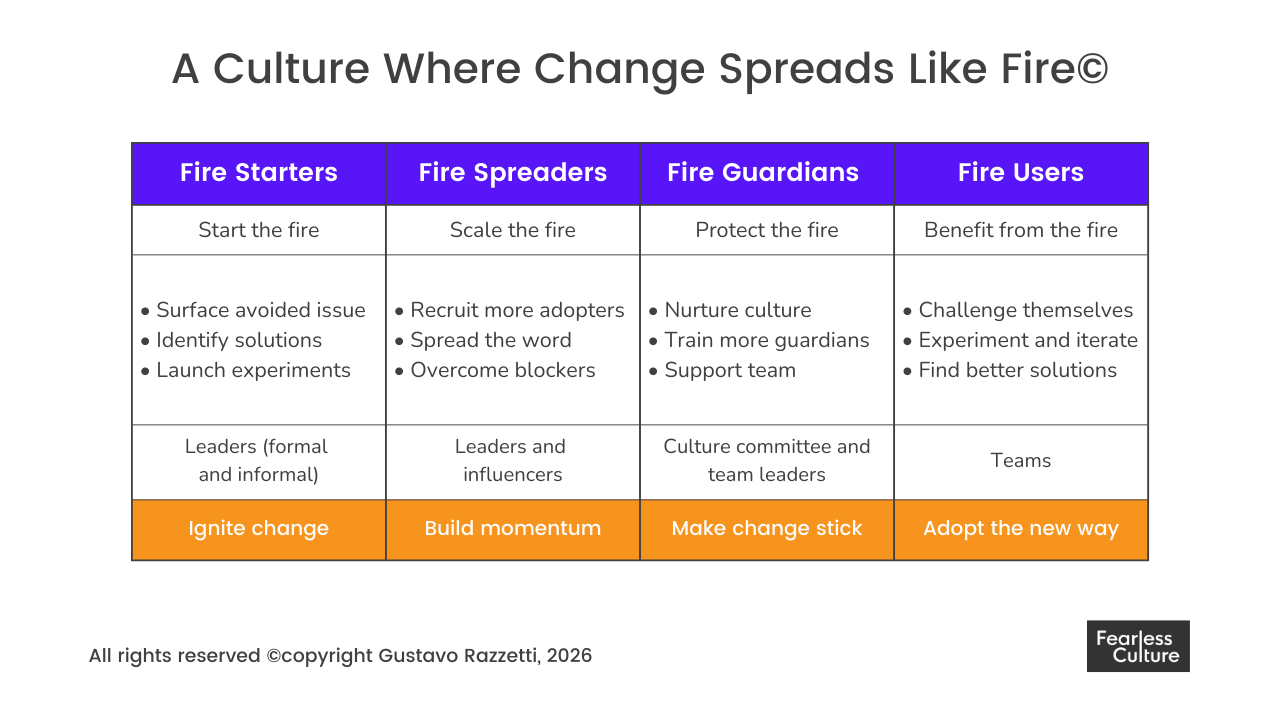
All roles matter. Some might sound more exciting than others, but Fire Starters alone won’t succeed. Each role requires specific skills and responsibilities. People should play to their strengths, not social expectations.
The roles aren’t tied to job titles. Leaders aren’t the only source of innovation. In fact, many leaders suck at this. The same goes for Fire Spreaders—you don’t need formal authority to bring others in. You can tap into any of the three types of power to spread new ideas: position power, expert power, and relationship power.
Finally, guarding the fire shouldn’t be an HR or People & Culture job. More people should be trained to support others, improve the system, and keep fires burning.
Building a Culture Where Change Catches Fire: A Four-Step Exercise
This exercise works for both teams and organizations. In this guide, we’ll assume you’re working with an executive team.
The Ideas That Catch Fire exercise follows four steps, in this order:
Reflect on your role (do this first, alone)
Define what makes good fires vs. bad fires
Map how ideas catch fire (using the canvas)
Define roles and assign people
