

100 Questions to Give and Receive Better Feedback
A practical guide for leaders, managers, and teams who want feedback that works.

Most feedback conversations fail before they begin. Not because feedback is inherently hard, but because we don’t prepare for it.
Think of feedback as a conversation, not a verdict. Like any difficult conversation, it goes better when both the giver and receiver show up ready. It works even better when both sides use the same approach.
That’s what this guide is for: a shared framework and 100 questions to help you give and receive feedback in a more honest, productive way.
Feedback is never easy. But it doesn’t have to be complicated. Use these questions as prompts to start the conversation, not rigid formulas.
The Five R’s Feedback Model
Before we jump into the question, let’s review the shared framework I mentioned above. It’s called the Five R’s of Feedback. I created it a few years ago to provide feedback givers and recipients a shared language, not just a simple process to follow.
It’s not a rigid checklist. It’s a conversation starter that includes five steps. Often, we limit the feedback discussion to the actual moment, the feedback conversation. But what happens before and after is equally important.
Think of the 5R’s of Feedback framework as a map to help navigate feedback conversations. When both givers and receivers use the same map, it’s easier to find common ground.
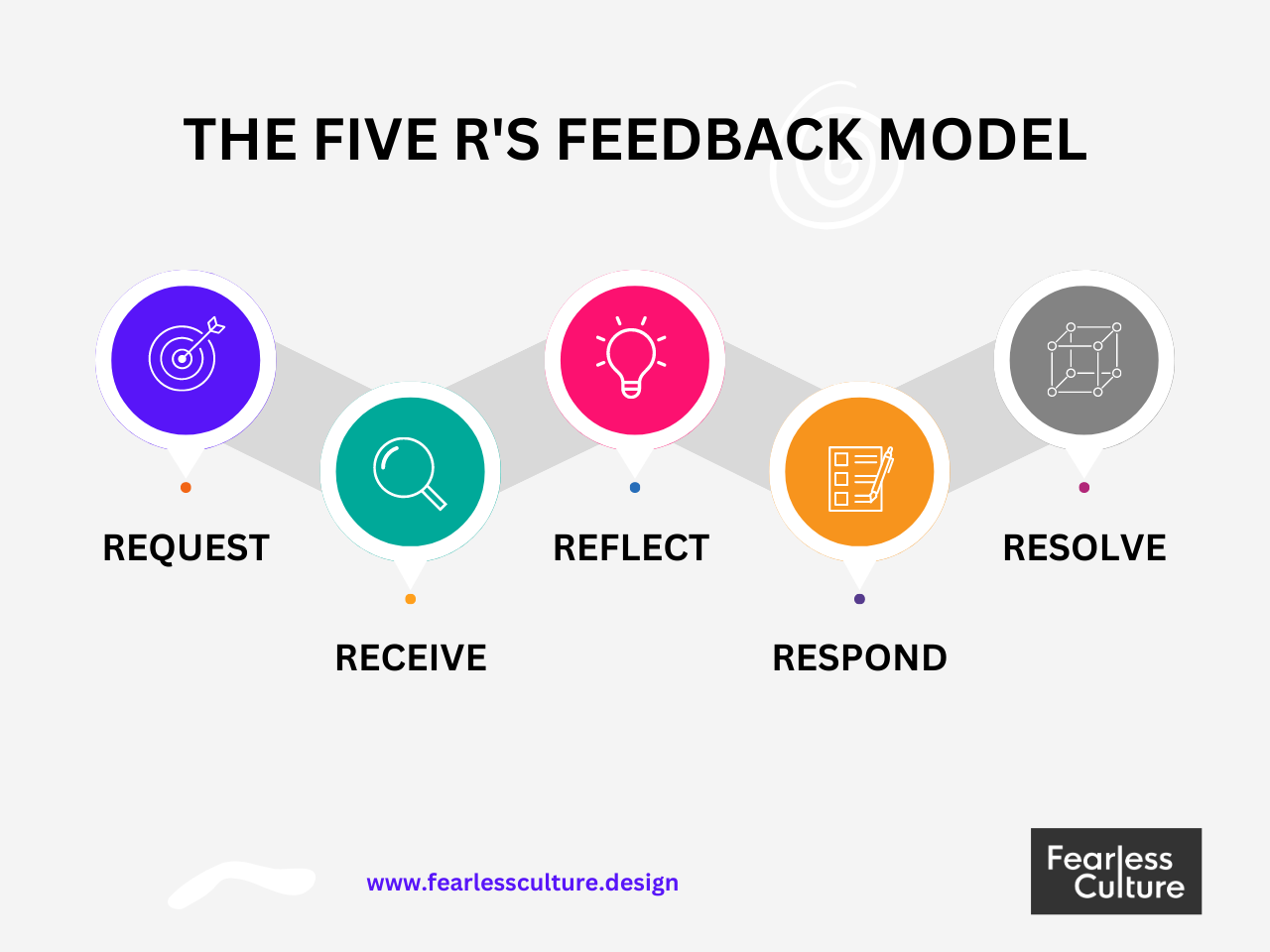
Here’s a brief overview of each step:
Request: Name what you need and ask for it. Asking for feedback helps you stay in control: you define the kind of feedback you want and from whom. It also makes it easier for the giver to be more specific. Skipping this step is starting a conversation on the wrong foot.
Receive: Listen without interrupting or rushing to explain yourself. Treat feedback as someone’s perspective, not the whole truth. If you’re giving feedback, be clear and specific. Focus on facilitating a conversation, not taking over it.
Reflect: Taking a pause works for both, but especially for the recipient. Sort what’s useful, what might be off, and the patterns you see. Feedback givers can use this break to reflect on the conversation and whether the message landed. This step is processing time: both parties take distance, allowing clarity and meaning to emerge.
Respond: Close the loop. Share what you will do, what you won’t, and why. Great feedback drives clarity; it doesn’t mandate a direction. If you’re the giver, help the other person see what they’re missing without dictating the solution. Focus on understanding over full agreement.
Resolve: Turn the conversation into action. Commit to specific changes and share your plan with the person who gave you feedback. As a giver, support people’s progress without micromanaging their journey. Without resolution, feedback is a waste of time.
Take the time to reflect on the different steps. Which do you find harder to deal with?
50 Questions for the Feedback Recipient
Receiving feedback well is a skill, not a personality trait. These questions help you stay open without shutting down and respond without losing your footing.
STEP 1: REQUEST
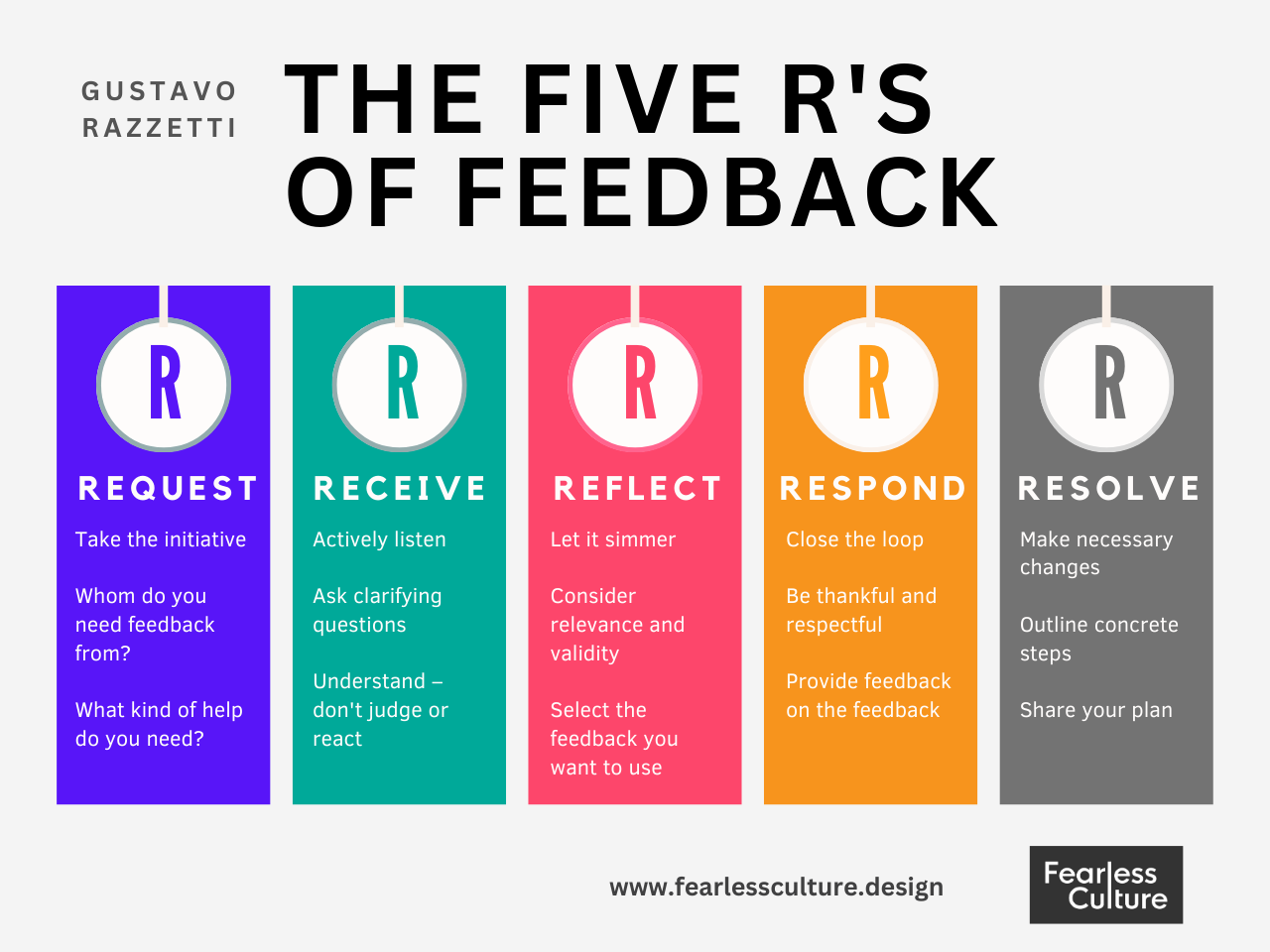
Take the initiative
Asking for feedback is the most underused power move in leadership. It puts you in control of what you hear, when you hear it, and from whom.
What do I want feedback on right now, and why now?
Who can give me the most useful perspective, and do I trust them to be honest?
How can I ask in a way that makes it easy for them to be candid?
What am I really looking for: validation, challenge, or a fresh perspective?
What have I done in the past that might make people reluctant to give me honest feedback?
STEP 2: RECEIVE
Listen actively
The hard part is not hearing tough feedback. The hard part is staying present when you want to explain, justify, or shut down.
What’s my default reaction when I hear something I disagree with, and how can I pause instead of reacting?
What might prevent me from fully hearing feedback?
What clarifying questions can help me understand the feedback, not just endure it?
How can I acknowledge what I heard without necessarily agreeing with it?
How will I show that I value the other person’s honesty?
STEP 3: REFLECT
Gain insight
Most feedback gets dismissed or over-accepted immediately. Pause and take time to separate signal from noise.
What’s the core message underneath my initial emotional reaction?
Have I heard something similar in the past? Is there a pattern?
How does this feedback align or conflict with how I see myself?
What might I be filtering out, exaggerating, or misreading?
What are the implications if this feedback is true, and what if it isn’t?
STEP 4: RESPOND
Close the loop
A good response is not agreement. It’s showing that you took it seriously.
What will I act on, and what will I not act on? Can I explain why?
What do I still need to clarify before I make a choice?
How can I share my reflections without coming across as defensive or dismissive?
What’s the right timing and setting for my response?
How can I make sure the feedback giver knows their honesty mattered?
STEP 5: RESOLVE
Turn it into action
Feedback without action is just talk. Commit to something concrete, and make it happen.
What are the one or two concrete things I’ll do differently?
How will I integrate this into my development, not just a to-do?
What does progress look like, and how will I measure success?
Who can support or coach me as I work on this?
How and when will I close the loop?
50 Questions for the Feedback Giver
Good feedback is a service, not a performance. These questions help you show up with clarity, empathy, and the humility to know that your perspective is one input — not the final word.
STEP 1: REQUEST
Be approachable
The best feedback givers aren’t the bluntest. They’re the most trusted. That trust is built before the conversation even starts.
Am I showing up as someone who is safe to be honest with?
Where am I genuinely qualified to give feedback on, and where should I hold back?
Am I grounding my feedback in behavior and impact, or am I judging the person?
What does this person need from me right now?
What do I need to do to ensure this isn’t a reaction to a single event disguised as feedback?
STEP 2: RECEIVE
Be helpful
Too much feedback is noise. Focus on what matters most.
Is my feedback specific, observable, and relevant, or is it vague?
Have I chosen the right setting and the right time?
What are the top two or three points I want to discuss, and what can I let go of?
How will I confirm that the other person understood my point?
Am I willing to be wrong about some of this?
STEP 3: REFLECT
Be empathetic
After the conversation, reflect on how the conversation went, not just what you said.
How did the person respond, and what does says about my delivery?
Did my feedback land as helpful or as judgment?
Was I trying to help, or to win the point?
How did this conversation affect the relationship?
What would I do differently next time?
STEP 4: RESPOND
Be humble
Feedback is a starting point for a conversation, not a verdict. Expect pushback, and stay open.
Am I open to their perspective on my feedback?
How will I respond if they disagree or reject most of what I said?
What context or clarification might they need from me?
Am I holding my views loosely enough to change my mind?
How can I show respect for their process, even if it looks different than mine?
STEP 5: RESOLVE
Be collaborative
The goal is ownership, not compliance. Help them take the wheel.
What ideas, not directives, might help them move forward?
How can I support progress without controlling the outcome?
Who else could be a helpful support or sounding board?
How and when will we check in on without micromanaging?
What can I change to help them succeed?
Better Feedback Requires Trust
These questions only work when the relationship is strong. That’s what a recent longitudinal study on feedback found: Preparation helps, but trust is the foundation. Before you ask any of these questions, ask this first:
Have I built enough trust that this person will actually hear me — and tell me the truth in return?
If the answer is no, start there. Feedback is only as strong as the relationship it travels through.
Want to build a culture of feedback? Reach out and let’s discuss how I can help you.
Frequently Asked Questions - Giving and Receiving Feedback
What is the Five R’s Feedback Model?
The Five R’s is a feedback framework developed by Gustavo Razzetti from Fearless Culture to help leaders and teams give and receive feedback more effectively. It outlines five steps — Request, Receive, Reflect, Respond, and Resolve — that apply to both giving and receiving feedback. It’s meant to provide a shared language, not a script.
What types of feedback should I ask for?
Growth feedback includes both appreciative feedback (what’s working, what you should keep doing) and constructive feedback (what could be improved). If you only request one type, you miss part of the picture. The most useful feedback conversations include both.
Why do most managers struggle to give feedback?
According to a Harris Poll survey, 69% of managers are uncomfortable communicating with employees, and 37% are uncomfortable giving direct, constructive feedback. They worry about damaging the relationship, triggering defensiveness, or not knowing how to structure the conversation. Preparation — the right framework and questions — reduces that discomfort significantly.
How do you prepare to receive feedback without getting defensive?
Preparation is the best defense against defensiveness. Define what you want feedback on. Remind yourself that feedback is perspective, not reality. Commit to listening first and responding later. Stay open. You don’t have to agree to anything in the moment.
What questions should a manager ask before giving feedback?
Before giving feedback, practice a quick check-in:
Is my feedback about behavior and impact, not personality?
What does this person need from me right now?
What are the one or two most important points?
Is this the right time and place for this conversation?
How often should leaders give feedback?
Research from Gallup and others consistently shows that regular, informal feedback is far more effective than infrequent formal reviews. Feedback integrated into weekly check-ins, 1:1s, and project debriefs creates a culture of continuous improvement. Quarterly or annual reviews alone are not sufficient.
How do you create a feedback culture in a team?
Building a feedback culture requires frequent, safe, and two-way conversations. Leaders can model asking for feedback (not just giving it), normalize peer-to-peer feedback, and make feedback a part of regular team conversations rather than a special event. A strong, trusting relationship is the foundation. People share honest feedback when they trust it won’t be used against them.
What are the most common mistakes when giving feedback at work?
Common mistakes include giving feedback that’s vague rather than specific, judging personality rather than behavior, saving feedback for formal reviews, giving too much at once, and not leaving space for the other person to respond. Another major problem is ego-driven feedback, where the giver is more interested in sounding smart than being helpful.
This guide is part of Fearless Culture’s ongoing work helping teams build cultures where Forward Talk conversations are the norm, not the exception.